Showing posts with label Nevada. Show all posts

Tuesday, July 28, 2015

Footsteps I


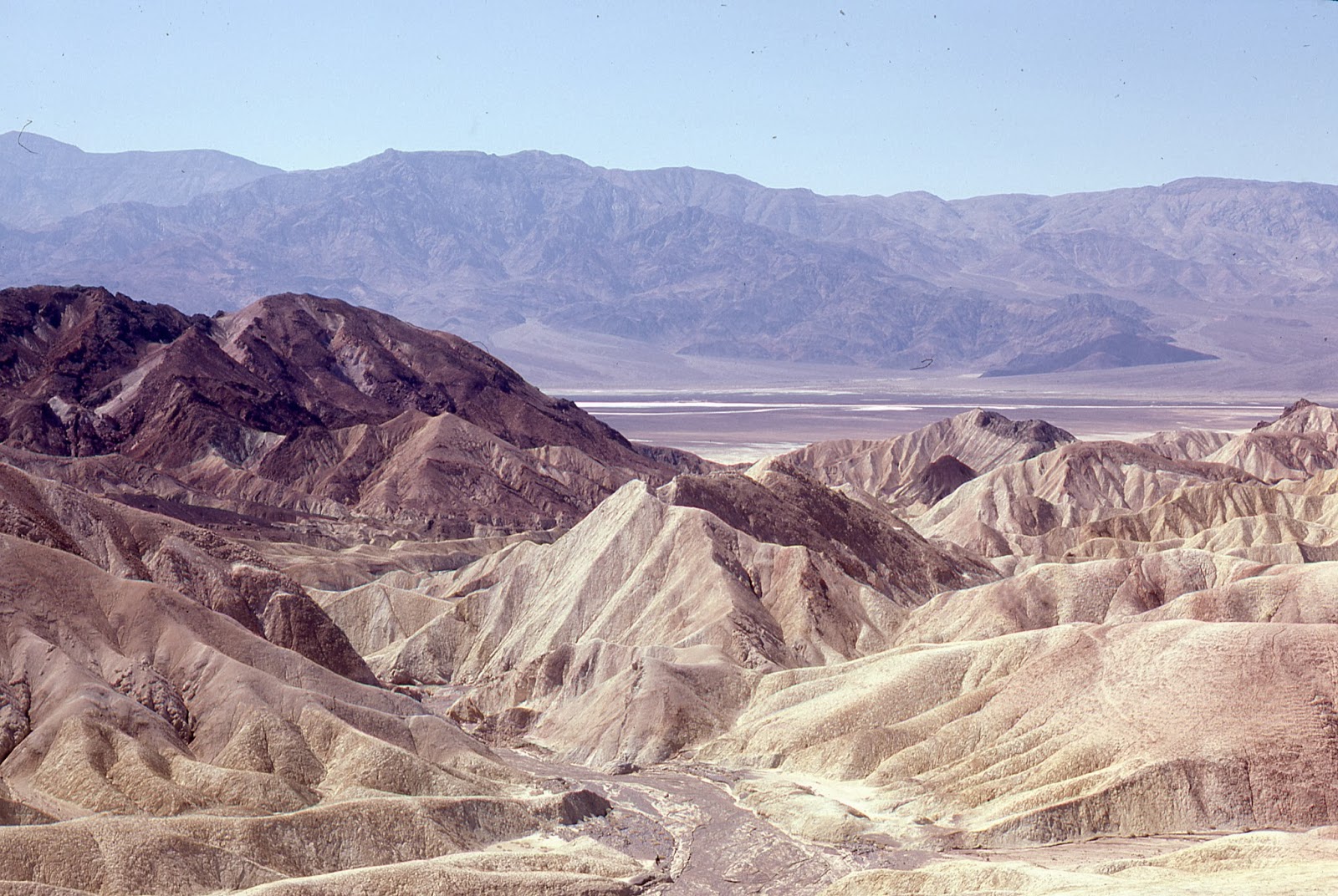
Much of Nevada can be a harsh and difficult land. (Photo by Tom Baugh)
I recently traveled to the western edge of the Great Basin in the US State of Nevada. In almost all ways this is a very big and mostly very lonely land. Except for major cities such as Reno in the northwest and Las Vegas far to the south, most other communities are relatively small and compact as if gathered-in against the immensity of the surrounding sagebrush and sand that dominates much of the area. On the west, the peaks of the Sierra Nevada mountain range pierce the frequently blue skies...skies broken by the highest peaks and only occasional contrails of very high-flying military and civilian jets. These mountains block what little rain Nevada receives from the Pacific Ocean in this time of increasingly severe drought in the western United States.  Author Mary Austin once referred to the area south of the site I was visiting as the 'land of little rain' and, mostly, that is the case for much of the Great Basin and the other desert regions east of California. The earth in these places range from a sandy yellow brown, to beige, to alkali white. The vegetation the dark green of Pinyon and blue-grey of sagebrush. Although these colors and tones are the general rule they are not exclusive.
Wheeler Peak, Nevada. (Photo by Tom Baugh)


Cemeteries and mine tailing dumps remind us of early Virginia City, Nevada. (Photo by Tom Baugh)
It was the exception to the desert tones and hues that had brought my son Kevin and I to this site in the shadow of Wheeler Peak. South of the Nevada state capitol at Carson City, the interstate highways spawned smaller two lane ribbons of asphalt leading to communities such as Smith and Yerington and,  old mining camps such as Aurora and, further south Bodie. Occasionally, we would pass bluish metal markers noting the historical significance of a particular site. There are a number of these historical site markers in Nevada, especially western Nevada, because a lot of history took place here.  The 49 ‘ers crossed these lands before ascending the steep and rugged eastern slopes of the Sierra Nevada range in search of the gold in California only to make the return trip in 1859 to establish the mineral-rich mines of Gold Hill, Silver City, and the queen of them all, Virginia City in Nevada’s Comstock Lode. 

Several of us have formed a study group to address Environmental Aesthetics. For those who are interested, please  contact me at springmountain1@att.net.

(Continued in next post)

Sunday, February 1, 2015

Water, Hot and Cold II


(Continued from preceding post)


Water in arid lands is always understandably fascinating and attracts life in many forms. Coyote, the small wild

canid now found throughout much of the United States, frequently hunt  round this small thermal site, and deer bed down in the adjacent willows. An occasional opportunistic mountain lion might wander down from the high country passing by numerous other smaller species including, birds, rodents, and reptiles.  In deserts, there is always the possibility that springs and seeps will host unique species. Our work at these springs revealed nothing especially unique in terms of biota.
For as long as there have been humans here, we have visited these thermal springs.  

The Native American people, many of whom still live close by, sought healing in these waters.  In 1849, and later, miners seeking wealth in the California gold fields passed this site on their way over the Sierras and then again as they returned from California on their way to the hoped-for riches of nearby Goldfield, Silver City, and Virginia City.  Nearby, the Mormons built a structured in a community that was called Mormon Station and later Genoa. 

As we wander among the grass and rushes, stepping carefully between the steaming  outlets, it is hard not to wonder what others left moccasin prints and the impressions of hobnailed boots on this alkali encrusted slope above the small pool where the cooling waters collect. Something different has brought each one of us here…healing, a hot bath, food…and knowledge.


(Continued in the next post)

Saturday, March 15, 2014

Alone III


Continued from the preceding post

There is something about being alone in the desert. As I said in an earlier posting, sometimes I had company when wandering the desert and sometimes not.  Traveling with a companion seems to fill those spaces in our spirit where we may not go very often.  But the doors to those spaces are open when you are alone. When you can see to the horizon where no structures and no indication of human occupancy or industry mar the view, you are alone. Where there is no other obvious animal life but a bird flitting across the dirt track you are driving on or a feral horse or burro standing on a low ridge in the distance, you are alone. I have often wondered if my observations were more acute and my science more precise when I was with others in the desert or alone.


One day a group of us were in Ash Meadows visiting with a ‘desert rat’ who had an old trailer there.  He was actually an engineer who treasured the solitude of the desert and who withdrew to his trailer and shade tree whenever possible.  This was the day that we heard that the US Congress had appropriated the funds necessary for the government to purchase Ash Meadows as an addition to the National Wildlife Refuge System.  I was surprised at how mixed my feelings were.  On the one hand, I was exceptionally pleased that the rich biodiversity would finally have lasting protection from the threat of exploitation or developers and agriculturists that had, for so long,  hung like the Sword of Damocles over this precious resource, this laboratory of evolution and biodiversity. On the other hand, I realized that the edgy days I had so enjoyed had come to an end.  Shortly after the purchase I left Nevada for another kind of desert…a desert of the spirit known as Washington, DC.


Saturday, March 1, 2014

Alone II


Continued from the preceding post

But most of my work focused on Ash Meadows including that strange rift in the crust of Earth called Devils Hole.  Back in the day, there were several ways to reach Ash Meadows. One route took you through what is now the Las Vegas bedroom community of Pahrump.  Another route was to drive north of Las Vegas for an hour or so, past Area 51 (with all of its reputedly strange goings-on), and turn left at the crossroads of Lathrop Wells almost across the street from the brothel with it’s deep red light. From Lathrop Wells the route takes you toward Death Valley Junction, with it’s unique opera house.  Just before you reached the Junction you would turn left again and head out across the desert at the cement factory.  Only in Nevada do you give directions by referencing Area 51 (As Agent Mulder might say, ‘The Truth is out there.’),  a brothel, and a cement factory. But this was the area in which we did some very exciting biology and conservation.

 
Strange things happened in that patch of desert in those times. Like the time that another student and I were driving into Ash Meadows from Pahrump only to be stopped by a Deputy Sheriff who refused to let us past because there was a body in the road. It was a man and he had been shot. We could see the body there in the dirt of the road with blood staining the gravel.  There were those in Las Vegas then (and I suspect even now who solved disagreements in a terminal manner).Shifting into four wheel drive, we circled the place of execution bumping through the sagebrush and across the stone-hard caliche.  As we came onto the main dirt and gravel road and drove on, I remember wondering how the man had died.  Was it quick or had he laid there bleeding his life out all alone in this this great, seemingly empty stretch of high desert …violent death in a land so filled with life. 


Continued in next post

Saturday, February 15, 2014

Alone I


Not long ago, a younger colleague asked me to reminisce about the years I spent wandering around the deserts of southern Nevada and southeastern California.  Questions like this sometimes make me feel even older than I am.  When I think about it, however, I’m now into my seventh decade and much of what I took part in has become a page in the history of an exciting story in conservation biology.  In fact, for that region of the world, the period from the late 1970’s to the mid-1980’s were epochal for the dozens of species of plants, fish, and invertebrates living in the high desert area above Death Valley know as Ash Meadow. 

Even as late as the 1980’s Ash Meadows and the surrounding area was still pretty wild.  I spent the opening half of that decade working on my first graduate degree at the University of Nevada, Las Vegas and then working for the University as a Research Associate.  There were times when everyone else was busy and I would take a university vehicle, if one was available, or my own vehicle and, alone. I would drive northwest of Las Vegas toward what was then called the Desert Game Range or Ash Meadows or down to the floor of Death Valley or even further north toward Beatty and the Armargosa River and, on some days, east and then north to Hiko and Crystal Springs and the White River Country.  Pupfish, springfish, and poolfish, and their habitats…during those years I joined them wherever they were found.
Continued in the next post
 

Friday, November 15, 2013

Finding Water


There are a number of ways of finding water. Some walk over the land with a forked willow limb in a practice called ‘dowsing’. Others, perhaps more scientifically, study the geology carefully…still others look at the vegetation. Some, like Craig Childs (The Secret Knowledge of Water) spend days, even months, in the field under very dangerous conditions, in order to find water. My son Kevin and I recently used history and a little of the above (but not dowsing or danger) to find water.

We were talking one day when he mentioned having read somewhere of the building of the Virginia & Truckee Railroad (1865-1959) in the northwestern part of the colorful US State of Nevada. The book or books indicated that upon reaching a certain mileage, those building the railroad bed had encountered water.  Kevin located the possible location and passed the information on to me.  I used Google Earth to follow the still existing railroad bed, sans tracks and ties, and right where it should be was a stand of green vegetation. 

In late October of 2013, along with the Nevada gathering of our family, we walked about three kilometers along the old roadbed until we came to the stand of willow I had seen on the Google Map.  At first it was difficult to tell, but after looking more carefully we saw the water!  There, at the base of what is called a ‘cut’ in the slope of the hillside, we found a shallow pool, 3-4 meters long, of very clear water.  The soil around the pool was hard-packed sand and gravel and did not take the impression of animal tracks very well. We could not tell what animals visited the site but in these very arid lands, this water is valuable to many species.  Our visit took place on the driest day of the year and yet there was water in this shallow basin. It snowed in northwestern Nevada the day after our visit to the seep.

The old railroad way is well known and is used by hikers, runners, and a number of other visitors.  I’m sure there are many who know of this permanent seep, certainly hundreds of recreationists pass it each week. Regardless, it is always exciting to ‘find’ water. I’m sure we’ll return some day.     

Thursday, September 12, 2013

Water in Dry Places


Decades ago, along with a friend and colleague, I drove across the high desert of northeastern Nevada to collect a small fish found in only one stream. After miles and miles of sagebrush desert, dry washes, and arid mountains, we overshot our target. We didn’t miss it we were just traveling too fast through that great lonely land to know when we’d arrived.  Stopping and turning around we parked on the sandy berm almost on top of where the stream flowed through a culvert under the road. There is something almost startling about water, of any sort, in such an arid place. In the years that followed, I encountered water in similar places from the springs that fed into the Salton Sea to the springs of Ash Meadows in the Death Valley Region of Nevada/California to floor of Death Valley itself.
There is something almost taunting about water in these environments. There is so little of it amid so much aridity.  In its aloneness, it is startling and often beautiful.  The waters of some of these springs appear to be turquoise while others are more clear than the finest crystal.  I will never forget being deeply submerged in the waters of Devils Hole and watching the bubbles on my SCUBA gear rise toward the distant surface, a small rectangle of turquoise far above me. Water in dry places, in desert lands also has a unique spiritual quality reflecting the both life’s tenacity and its impermanence.

Friday, August 23, 2013

Sacred Substance


If there is a sacred substance on this planet, one that is holy beyond all else, it is not a wafer of pressed bread or a cup of wine, it is water. For, without water, life on Earth (or anywhere else that we know of) is impossible.  Without water life would not have become. Without water life would not have evolved. And, without water life would not be. And yet, like many of our gods we have also consistently abused and crucified this sacred substance.  We have poured our bodily wastes into water since the beginning of collective life in towns and cities. In the name of that very suspect ’progress,’  we have emptied our industrial waste into the rivers and streams, and the arteries of polluted water have burst into flame.

 In Asia the extraction of groundwater for fish culture is causing subsidence of the land.  In the Middle East water wars brew among the increasingly arid sands. In Japan radioactive poisons flow into the waters of the Pacific Ocean. In southern Nevada, the progeny of organized crime have acquired the rights to every drop of water from springs and streams to feed the thirst of Las Vegas.  Even when all the springs are sucked dry, there still won’t be enough water and the tourists will have to learn to drink their own recycled piss. Our theologies teach us that it’s not a good idea to offend our gods and it surely is not a good idea to continue to offend water.  Water may not be the kind of god our many theologies have led us to expect but its continued abuse will inevitably lead to the kind of punishment  we are told our oddly antagonistic gods often impose.


Friday, February 15, 2013

Playing In The Mud II


 Continued from the previous post


Although it can be fun playing in the mud by yourself, it is often as enjoyable to have friends and colleagues with you.  It was for this reason that in fall of 2012 I posted a message on a couple of scientific lists that I was looking for someone(s) to play in the mud with.  The response was quick and gratifying and within a short time I had gathered dozens and dozens of scientists and practitioners.  We call ourselves the Groundwater Wetland Study Group and I’m in very good company! The focus of the Study Group is on seeps, springs, bogs, fens, and other groundwater-dependent wetland systems.                                Our members are working on projects from thermal wetlands in the American deserts to perched lakes in Tasmania to projects in the Mekong Delta of Vietnam. The Study Group is an  international organization with members in Nigeria, Romania, Brazil, Vietnam, and The United Kingdom, among a number of other places. Our members represent government on several levels, business, environmentalists, independents, and the academic world.  The Study Group currently hosts a Yahoo Group, and is guided by a Leadership Cadre. 


For additional information on the Groundwater Wetland Study Group contact Tom Baugh at 
springmountain1@att.net.


Friday, February 1, 2013

Playing In The Mud I


Ever since I was a child I have enjoyed playing in the mud. I have played in the mud for six decades ranging from wetlands of various sorts on the West coast of the US to springs in the deserts of Nevada and California to the US Gulf Coast out into the Caribbean and to the mountains of the southern Appalachians. As my wife of 51 years can tell you, I still enjoy playing in the mud.  Now that I am no longer indentured to a 9-5 yoke, I can play in the mud whenever I want. I use the term ‘mud’ loosely. Perhaps playing in the water would better describe my professional interests.  Although there has been a lot of mud in the places I have worked, there have also been some pristine waters…crystal seeps and springs and streams still clear enough to look drinkable (not a good idea these days).

Several posts back I spoke of Bat Fork Bog Plant Conservation Preserve near my home in the Southern Appalachian Mountains of Western North Carolina. No crystal seeps or springs there…just mud and a little water and an endangered plant species. My current work has me at the toe of the Sierra Nevada Mountain Range in Northwestern Nevada several times each year where thermal springs bubble up from the Genoa Fault filling the air with the smell of sulfur before flowing down slope to help form a backwater wetland to the Carson River.  Water, mud, odors…ah, the stuff of life!

See the next post for information on the Groundwater Wetlands Study Group (springmountain1@att.net).