Showing posts with label springs. Show all posts

Tuesday, September 15, 2015

Reflections on A Pool of Still Water


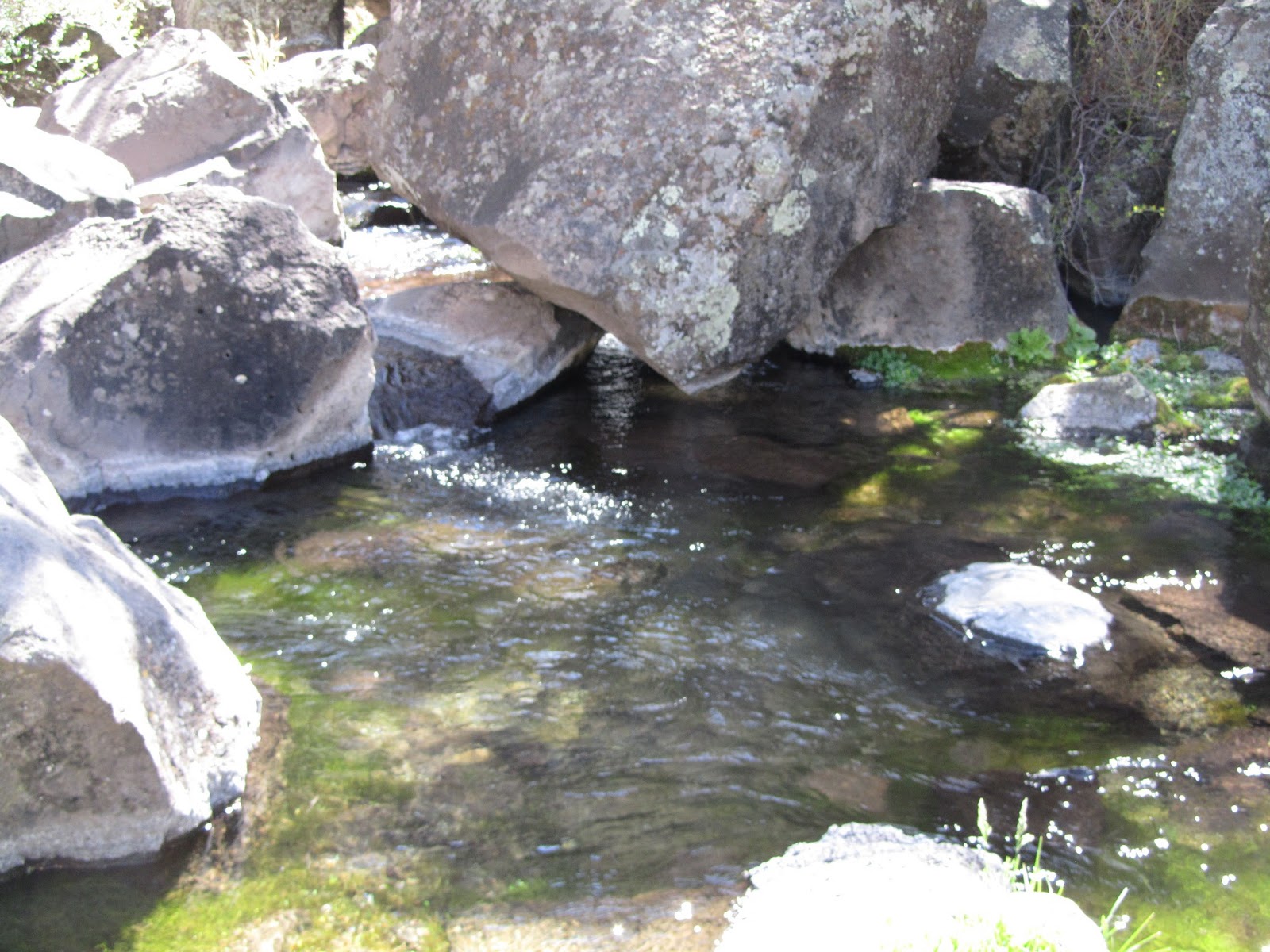
I doubt that there is anything in the environment that attracts me more quickly or engages my attention and fixes me so raptly, than a pool of still water. The context doesn’t even seem to matter much. A pool alongside a path through the woods or bubbling from sandy desert soil in the natural environment or a decorative water feature in the built environment, are like magnets pulling me to them and through them and into them.

I never even feel the water close over my head as my mind and spirit slip beneath the glassy, still surface. I never feel my mental gills begin to function as I slip deeper and deeper into the water. The objective pool may only be inches deep but subjectively I am rapidly and fully submerged and enveloped.  My eyes never blur or burn as my spirit opens to the shoals of tiny, darting silvery fish, the vegetation reaching for the surface and the sun, or the quietly resting frog.

It has been this way since I was a child, since my Grandmother took me to a ‘pet shop’ where I peered into my first aquarium or sat by the side of the first fish pond I had ever seen with orange-gold fish, their tails and fins moving in wavy streamers in the green algae stained water.

Over the decades I’ve looked into hundreds of aquariums and many fish ponds and my response never varies. Mind and spirit gently slip beneath the surface.


There is a debate in Environmental Aesthetics between cognitive and noncognitive theories…objective information based on science and more subjective, less fact-based approaches.  I have to wonder who I am. Where am I in this debate? It has been several undergraduate and graduate degrees since those early pet shop visits and I can explain in the most intimate detail what is happening chemically, physically and ecologically in this special wet world of mine...I know its secrets. I have physically slipped beneath the surface, breathing from a cylinder on my back, and hung mesmerized over the void 120 feet down on a Caribbean reef. I have snorkeled among an incredible plethora of life in shallow lagoons, and have dived deep into flooded desert caves and I have substantial scientific knowledge of those habitats and ecosystems. But those shallow pools, of which I also have great scientific knowledge, continue to call me, not so much as a scientist but in a spiritual sense. I’m not a religious person so perhaps all of this is what  E.O. Wilson refers to as ‘Bioiphilia,’ the human bond with other species. Perhaps I’ll never know the answer but I’m very comfortable with the question.

Several of us have formed a study group to address Environmental Aesthetics. For those who are interested, please  contact me at springmountain1@att.net.
 

Saturday, August 15, 2015

Footsteps II


(Continued from preceding post)

This is a place of vast stretches of arid land. (Photo by Tom Baugh)
We were searching for the emerald green of rare springs and seeps. (Photo by Tom Baugh)
Gold and Silver are evocative colors but on this trip and many others before it, we were searching not for mineral wealth but another kind of wealth and another color. It was emerald we were looking for, not the emerald of the gemstone but the startling plant-green of those rare oasis of  vegetation surrounding springs that very infrequently seep from the base of hills alongside the two-lane country roads. Native American people were the first humans to visit these small islands of green with their cool waters and sheltering willow and cottonwood trees. It didn’t take long for wandering Europeans, following the course of the Carson and Walker rivers and to stake their claim. Domestic livestock would soon graze in what would one day be called wet meadow complexes.  In fact, the complex we had been asked to visit was the site of an old stagecoach stop on the dusty gravel trail from one western Nevada mining camp to another. In our soon sopping tennis shoes we squished along trails where stagecoach stock had once been turned out to graze and moccasins and hobnailed boots had wandered.  In one way or another everyone who came here left their mark. In fact, our visit was, in part, to help erase at least some of those earlier marks. but there was really very little left for us to do because the current landowner had a strong sense of stewardship.


Ours were not the first footprints in these wet meadows. (Photo by Tom Baugh)
Several of us have formed a study group to address Environmental Aesthetics. For those who are interested, please  contact me at springmountain1@att.net.

(Continued in next post)

Monday, July 1, 2013

A Deep Place in the Earth III


Continued from the preceding post.


Looking down at the Rio Grande from the rim rock. (Photo by Tom Baugh)
As I have said several times before in this blog, I’m attracted to the study of water…I like to play in the mud.  In early May 2013 this attraction led me, along with my artist wife Penny Baugh (http://artjourney-penny.blogspot.com) to the edge of the Rio Grande Gorge in an area referred to by the USDI Bureau of Land Management (BLM) as the Wild Rivers Recreation Area.  The Rio Grande and the Red River flow through this region of sagebrush, pinyon pine and juniper.  But it was the Rio Grande that called to us this day.  We had decided to walk down into the canyon 800 feet below to visit Big Arsenic Springs. 
Big Arsenic Springs on the Rio Grande. (Photo by tom Baugh)
The trail dropped away steeply below our perch down through layers and layers of ancient lava flows until rock flowed into water.  From high above, the river looked peaceful along some stretches and turbulent with white water along others.  In driving along the miles of roads and through the thousands of acres leading into the site we had not seen another human since the community of Cerro some miles back.  The BLM visitor center was closed. And there were no other cars on the roads or parked at the campsites. To the best of our knowledge, we were alone in the immensity.  It was a very liberating, and I suspect these days a very rare, experience.  

Our descent along the crumbly surface of the trail took longer than any other mile-long stretch we have ever walked.  But eventually we reached Big Arsenic Spring at the river’s edge.  According to the story, possibly a myth, the spring was named by a hermit who wanted to keep the water all to himself.  Perhaps somebody finally did the science, found out that this was not an arsenic spring, and the hermit lost his exclusivity.  A flow of 5000 gallons per minute makes Big Arsenic Springs a rarity in this parched region of the earth.  This artesian, subaqueous spring rushes from the base of a great tumble of lava rock and bursts out into the river in a white plume.   We had the spring all to ourselves that morning and it was not until our journey back up the trail, when we had almost reached the rimrock, that we encountered a party of four, the first humans we had seen that day.

The canyon rim above the Rio Grande. (Photo by Tom Baugh)

Saturday, June 15, 2013

A Deep Place in the Earth II


Continued from the preceding post.


The lower end of the Rio Grande Gorge near Pilar, NM. (Photo by Tom Baugh
We also had the opportunity to visit the river at the lower end of the Gorge, near the community of Pilar, New Mexico.  This is a different river, more gentle and much less dramatic.  A road winds along the east bank of the river through the small community of Pilar and up river past Bureau of Land Management campsites until it ends at the confluence of the Rio Grande with the Rio Pueblo de Taos.
The Rio Pueblo de Taos is the same stream that passes through the Pueblo community of Taos on the north side of the present day tourist community of Taos. From Pilar the river flows south through increasingly open and arid land, exits New Mexico, enters the US state of Texas, and eventually joins with the Gulf of Mexico.  Although this lower end of the Gorge is beautiful, it is for some reason here that one becomes increasingly aware of the aridity of this region of North America. During the days that we spent in the Taos area we never purchased a local or regional newspaper that failed to mention the declining water resources of the region.  It is difficult to conceive of anything that will, over the long run, increase the amount of water available to New Mexico.  And yet growth continues to outstrip the sparse water resources.  The situation here is no different than that facing many other parts of the world.  Our populations continue to grow, our needs for natural and processed resources continue to expand but water, the most essential resource of all and the most limiting next to air, continues to decline.
A very small seep from a volcanic hillside above the Rio Grande (Photo by  Tom Baugh)


Continued in the next post.

Saturday, June 1, 2013

A Deep Place in the Earth I


Rio Grande River hundreds of feet below the bridge. (Photo by Tom Baugh)
My wife Penny (http://artjourney-penny.blogspot.com) and I recently had the opportunity to visit the Rio Grande Gorge in the northwestern part of the US state of New Mexico.  Although not as deep and nowhere near as wide as the Grand Canyon, the Rio Grande Gorge is a very impressive rift, a very deep place in the Earth.  The Taos Mesa is an immense extent of sagebrush covered land, dotted here and there with the signs of humanity,  that stretches for miles. Even on a sunny day there is a brooding aspect to this place.  The frequent patchy clouds sail across the sky, pushed by the ever present winds, and darken the earth below in great shifting patches of a natural melancholy.

Dwarf yucca among the lava boulders. (Photo by Tom Baugh)
You can visit the Gorge in several different ways.  For example, you can drive across the Gorge on a bridge located a little north and west of the community of Taos.  The Gorge isn’t obvious until you are right upon it.  One moment you are driving on a hard asphalt surface with high desert seemingly on all sides and in the next moment you are suspended in space on a thin ribbon of concrete and steel with the Rio Grande winding far below and nothing but very empty space under you. It can be a breath-taking experience to come upon  the Gorge and its namesake river in this way.  This is an incredibly fractured lava land with great chucks of black rock descending from the rims of the Gorge deep into the river itself.  

Continued in the next post.