Tuesday, October 15, 2013

Water In Home Places


We are very fortunate at Hidden Springs where our home is perched over a number of springs that fill a pool that may hold as much as 5,000 gallons.  Those springs and pool are at the lower end of the land we steward.  Even with natural springs we have brought water into closer proximity to our home.  Visitors to our front door are greeted with a small pool fed by a trickle of recirculated water that sounds like the tinkling of tiny crystal bells. The window in the studio of my artist wife Penny (http://artjourney-penny.blogspot.com) looks out over what we call the Studio Gardens complete with an ornamental pond, water lilies and other plants, frogs, and the frequent raccoon or two. One additional ‘water feature’ is located on the slope below the window in my study.  I can’t see it but I often see the other residents of Hidden Springs who come to water there.  During the late summer of 2013 an Eastern Whitetail doe had her fawn in the rhododendrons within a few feet of the house.  For the first few days, while her fawn was growing steady legs she took water from the small pool below the Study window.  It may be that the oldest recorded water gardens, or perhaps water features, were in what is called the Cradle of Civilization in Mesopotamia thousands of years ago. But the idea either spread rapidly or occurred almost simultaneously involving Egypt, Assyria, Babylonia, China, India, Japan, Rome, Persia and a number of other places among the evolving peoples of Earth.  What is it that we look for in these often quiet places and still waters?

Tuesday, October 1, 2013

Water in Wet Places


Living in the southern end of the Appalachian Mountains, one can become jaded about water. There is a lot of it here.  Often the streams and ditches run full.  Almost every low place is a puddle complete with frogs and dragonflies.  Only a few minutes from our home at Hidden Springs is an area that boasts literally hundreds of waterfalls.  And, according to climate change models, it is supposed to get wetter here in these mountains. 

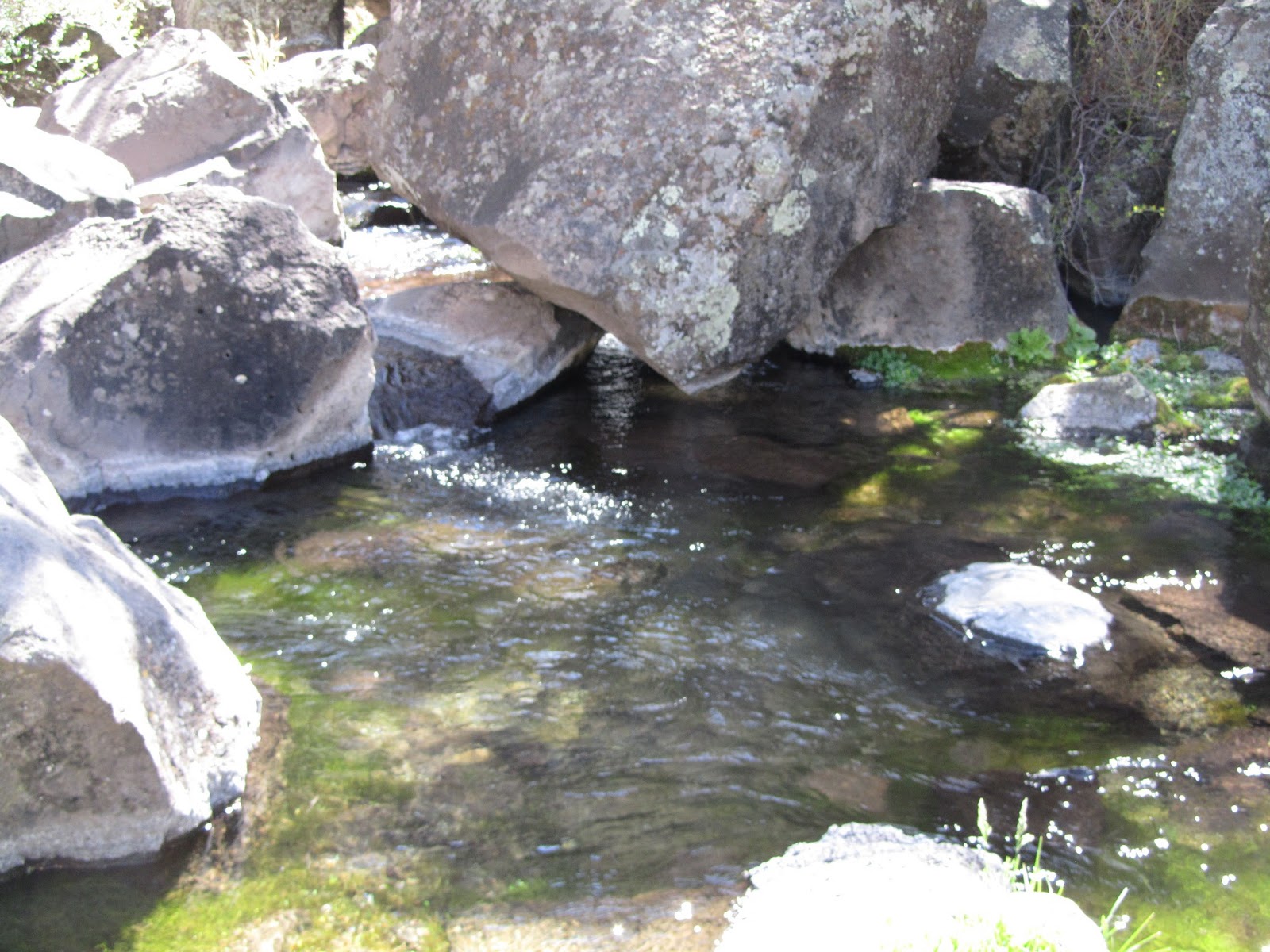
It is easy to take all of that water for granted unless, like me, you were raised in a very dry place where you don’t take water for granted…not even a tiny trickle or a stagnant pool.  Even in a place literally overflowing with water some places are special.  For example, there is a small stream only a few miles from our home.  Not much more than a trickle, this stream wanders down a canyon beside a trail.  There is one place along the trial where I always stop to take a closer look at the stream.  At this spot the stream flows into a quiet, shallow pool. The pool is surrounded by lush grass and framed by a fallen long. I’m not sure what it is about this spot that grabs my attention.  I suspect it might be something about the peace that I feel here and, possibly, the harmony with which Nature has arranged the elements of the place.  I think most of us seek these special places in our lives, at least those of us who have some sense of the wild and the beauty in Nature.

Thursday, September 12, 2013

Water in Dry Places


Decades ago, along with a friend and colleague, I drove across the high desert of northeastern Nevada to collect a small fish found in only one stream. After miles and miles of sagebrush desert, dry washes, and arid mountains, we overshot our target. We didn’t miss it we were just traveling too fast through that great lonely land to know when we’d arrived.  Stopping and turning around we parked on the sandy berm almost on top of where the stream flowed through a culvert under the road. There is something almost startling about water, of any sort, in such an arid place. In the years that followed, I encountered water in similar places from the springs that fed into the Salton Sea to the springs of Ash Meadows in the Death Valley Region of Nevada/California to floor of Death Valley itself.
There is something almost taunting about water in these environments. There is so little of it amid so much aridity.  In its aloneness, it is startling and often beautiful.  The waters of some of these springs appear to be turquoise while others are more clear than the finest crystal.  I will never forget being deeply submerged in the waters of Devils Hole and watching the bubbles on my SCUBA gear rise toward the distant surface, a small rectangle of turquoise far above me. Water in dry places, in desert lands also has a unique spiritual quality reflecting the both life’s tenacity and its impermanence.

Friday, August 23, 2013

Sacred Substance


If there is a sacred substance on this planet, one that is holy beyond all else, it is not a wafer of pressed bread or a cup of wine, it is water. For, without water, life on Earth (or anywhere else that we know of) is impossible.  Without water life would not have become. Without water life would not have evolved. And, without water life would not be. And yet, like many of our gods we have also consistently abused and crucified this sacred substance.  We have poured our bodily wastes into water since the beginning of collective life in towns and cities. In the name of that very suspect ’progress,’  we have emptied our industrial waste into the rivers and streams, and the arteries of polluted water have burst into flame.

 In Asia the extraction of groundwater for fish culture is causing subsidence of the land.  In the Middle East water wars brew among the increasingly arid sands. In Japan radioactive poisons flow into the waters of the Pacific Ocean. In southern Nevada, the progeny of organized crime have acquired the rights to every drop of water from springs and streams to feed the thirst of Las Vegas.  Even when all the springs are sucked dry, there still won’t be enough water and the tourists will have to learn to drink their own recycled piss. Our theologies teach us that it’s not a good idea to offend our gods and it surely is not a good idea to continue to offend water.  Water may not be the kind of god our many theologies have led us to expect but its continued abuse will inevitably lead to the kind of punishment  we are told our oddly antagonistic gods often impose.


Monday, July 1, 2013

A Deep Place in the Earth III


Continued from the preceding post.


Looking down at the Rio Grande from the rim rock. (Photo by Tom Baugh)
As I have said several times before in this blog, I’m attracted to the study of water…I like to play in the mud.  In early May 2013 this attraction led me, along with my artist wife Penny Baugh (http://artjourney-penny.blogspot.com) to the edge of the Rio Grande Gorge in an area referred to by the USDI Bureau of Land Management (BLM) as the Wild Rivers Recreation Area.  The Rio Grande and the Red River flow through this region of sagebrush, pinyon pine and juniper.  But it was the Rio Grande that called to us this day.  We had decided to walk down into the canyon 800 feet below to visit Big Arsenic Springs. 
Big Arsenic Springs on the Rio Grande. (Photo by tom Baugh)
The trail dropped away steeply below our perch down through layers and layers of ancient lava flows until rock flowed into water.  From high above, the river looked peaceful along some stretches and turbulent with white water along others.  In driving along the miles of roads and through the thousands of acres leading into the site we had not seen another human since the community of Cerro some miles back.  The BLM visitor center was closed. And there were no other cars on the roads or parked at the campsites. To the best of our knowledge, we were alone in the immensity.  It was a very liberating, and I suspect these days a very rare, experience.  

Our descent along the crumbly surface of the trail took longer than any other mile-long stretch we have ever walked.  But eventually we reached Big Arsenic Spring at the river’s edge.  According to the story, possibly a myth, the spring was named by a hermit who wanted to keep the water all to himself.  Perhaps somebody finally did the science, found out that this was not an arsenic spring, and the hermit lost his exclusivity.  A flow of 5000 gallons per minute makes Big Arsenic Springs a rarity in this parched region of the earth.  This artesian, subaqueous spring rushes from the base of a great tumble of lava rock and bursts out into the river in a white plume.   We had the spring all to ourselves that morning and it was not until our journey back up the trail, when we had almost reached the rimrock, that we encountered a party of four, the first humans we had seen that day.

The canyon rim above the Rio Grande. (Photo by Tom Baugh)

Saturday, June 15, 2013

A Deep Place in the Earth II


Continued from the preceding post.


The lower end of the Rio Grande Gorge near Pilar, NM. (Photo by Tom Baugh
We also had the opportunity to visit the river at the lower end of the Gorge, near the community of Pilar, New Mexico.  This is a different river, more gentle and much less dramatic.  A road winds along the east bank of the river through the small community of Pilar and up river past Bureau of Land Management campsites until it ends at the confluence of the Rio Grande with the Rio Pueblo de Taos.
The Rio Pueblo de Taos is the same stream that passes through the Pueblo community of Taos on the north side of the present day tourist community of Taos. From Pilar the river flows south through increasingly open and arid land, exits New Mexico, enters the US state of Texas, and eventually joins with the Gulf of Mexico.  Although this lower end of the Gorge is beautiful, it is for some reason here that one becomes increasingly aware of the aridity of this region of North America. During the days that we spent in the Taos area we never purchased a local or regional newspaper that failed to mention the declining water resources of the region.  It is difficult to conceive of anything that will, over the long run, increase the amount of water available to New Mexico.  And yet growth continues to outstrip the sparse water resources.  The situation here is no different than that facing many other parts of the world.  Our populations continue to grow, our needs for natural and processed resources continue to expand but water, the most essential resource of all and the most limiting next to air, continues to decline.
A very small seep from a volcanic hillside above the Rio Grande (Photo by  Tom Baugh)


Continued in the next post.

Saturday, June 1, 2013

A Deep Place in the Earth I


Rio Grande River hundreds of feet below the bridge. (Photo by Tom Baugh)
My wife Penny (http://artjourney-penny.blogspot.com) and I recently had the opportunity to visit the Rio Grande Gorge in the northwestern part of the US state of New Mexico.  Although not as deep and nowhere near as wide as the Grand Canyon, the Rio Grande Gorge is a very impressive rift, a very deep place in the Earth.  The Taos Mesa is an immense extent of sagebrush covered land, dotted here and there with the signs of humanity,  that stretches for miles. Even on a sunny day there is a brooding aspect to this place.  The frequent patchy clouds sail across the sky, pushed by the ever present winds, and darken the earth below in great shifting patches of a natural melancholy.

Dwarf yucca among the lava boulders. (Photo by Tom Baugh)
You can visit the Gorge in several different ways.  For example, you can drive across the Gorge on a bridge located a little north and west of the community of Taos.  The Gorge isn’t obvious until you are right upon it.  One moment you are driving on a hard asphalt surface with high desert seemingly on all sides and in the next moment you are suspended in space on a thin ribbon of concrete and steel with the Rio Grande winding far below and nothing but very empty space under you. It can be a breath-taking experience to come upon  the Gorge and its namesake river in this way.  This is an incredibly fractured lava land with great chucks of black rock descending from the rims of the Gorge deep into the river itself.  

Continued in the next post.